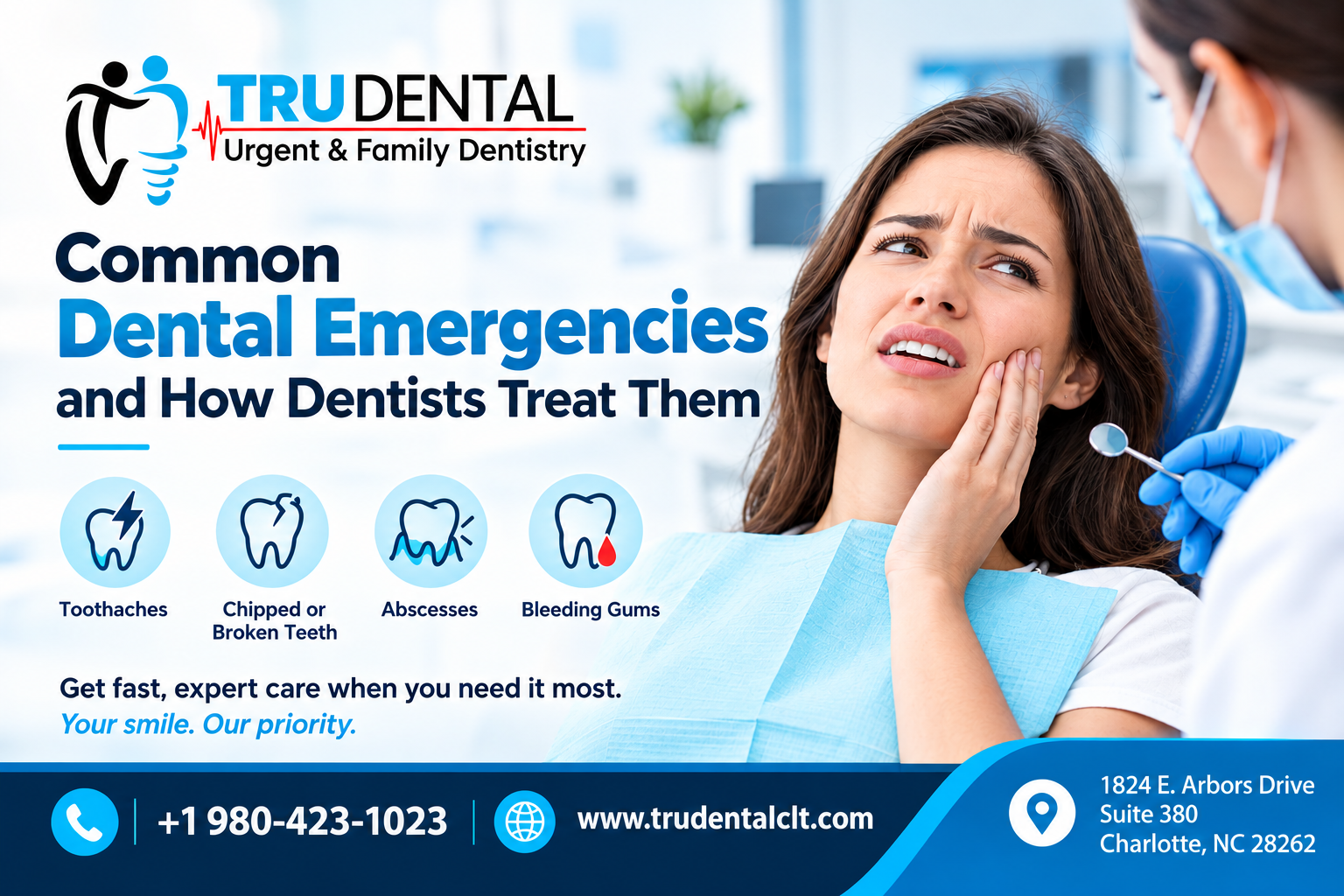
A toothache that won’t quit. A tooth that breaks during dinner. A child who takes a tumble at a Saturday soccer game. Dental emergencies rarely wait for a convenient moment, and they almost never happen during regular office hours. When pain strikes, knowing what to do (and where to go) makes all the difference.
At TRU Dental in Charlotte, we see these situations every weekend. So let’s walk through the most common dental emergencies, how dentists treat them, and when you really shouldn’t wait to get help.
Severe Toothache
A bad toothache is one of the most common reasons people call us. The pain can come from decay, an infection deep inside the tooth, or pressure from a problem developing under the surface.
To find the cause, your dentist will examine the tooth, ask about your symptoms, and often take an X-ray to see what’s happening below the gum line. Treatment depends on what’s behind the pain. Sometimes a filling solves it. Other times you may need a root canal to clean out infection and save the tooth. The goal is always to stop the pain first, then fix the root of the problem.
Broken or Chipped Tooth
Biting down on something hard, a fall, or an old, weakened tooth can all lead to a crack or chip. A small chip might just be a cosmetic concern, but a deeper break can expose the sensitive inner part of the tooth and cause real pain.
Your dentist will check how far the damage goes. A minor chip can often be smoothed or repaired with bonding. A larger break may need a crown to protect and rebuild the tooth. If the break reaches the nerve, a root canal followed by a crown is usually the answer.
If you have a broken tooth, save any pieces you can and rinse your mouth gently with warm water until you can be seen.
Knocked-Out Tooth
A completely knocked-out tooth is a true emergency, and time matters a lot. The sooner you act, the better the chance of saving it.
Pick the tooth up by the crown (the top part), never the root. Rinse it gently without scrubbing. If you can, place it back in the socket and hold it there. If that’s not possible, tuck it in a cup of milk and head to the dentist right away. Your dentist will try to reinsert and stabilize the tooth, often splinting it to the neighboring teeth while it heals.
Lost Filling or Crown
Losing a filling or crown can leave a tooth feeling sharp, sensitive, or just plain uncomfortable. While it may not seem urgent, the exposed tooth is more vulnerable to damage and decay.
If you still have the crown, keep it safe and bring it with you. Your dentist will check whether it can be re-cemented or whether a new one is needed. For a lost filling, they’ll clean the area and replace it to seal and protect the tooth again.
Dental Abscess
An abscess is a pocket of infection, usually at the root of a tooth or in the gums. It often shows up as throbbing pain, swelling, a bad taste, or even a fever. This is one emergency you should never ignore, because the infection can spread.
Your dentist will diagnose it with an exam and digital CBCT technology , then work to drain the infection and clear it up. Treatment may include antibiotics, a root canal, or in some cases removing the tooth. Quick care brings relief and keeps the problem from getting worse.
Wisdom Tooth Pain
Wisdom teeth have a habit of causing trouble. They can become impacted, grow in at an angle, or crowd the teeth around them. The result is often aching, swelling, and stiffness in the jaw.
Your dentist will take a digital CBCT technology to see how the wisdom tooth is positioned. If it’s the source of your pain or infection, removing it is usually the best path forward. Many of our patients are surprised by how quick and comfortable the process can be once the tooth is out and the pain is gone.
Swelling in the Mouth or Face
Swelling around the gums, jaw, or face often points to infection or trauma. It can be uncomfortable and, in some cases, a sign of something serious.
A dentist will examine the area to find the source and treat it accordingly, whether that means draining an infection, prescribing medication, or addressing an injured tooth. Don’t wait this one out, especially if the swelling is spreading or you’re having trouble swallowing or breathing.
When Should You Seek Immediate Care?
Some dental problems can wait until Monday. Many can’t. Reach out for emergency care right away if you have:
- Severe or worsening pain that won’t ease up
- A knocked-out or badly broken tooth
- Bleeding that won’t stop
- Swelling in the face, jaw, or gums
- Signs of infection like fever or a bad taste
- Trouble swallowing or breathing (in this case, head to the ER)
When in doubt, it’s always better to call and ask. A quick conversation can help you figure out the next step.
Weekend Dental Emergency in Charlotte? We’re Here for You
Pain doesn’t keep office hours, and neither do we. TRU Dental is open every Friday, Saturday, and Sunday from 12 PM to 12 AM, so you can get the care you need when most offices are closed.
We welcome new patients and offer same-day appointments for emergencies. From tooth extractions and root canals to crowns and general dental care, our team handles it all under one roof, in a calm and welcoming space.
If you’re dealing with a dental emergency in Charlotte, don’t tough it out alone. Call us at (980) 423-1023 or book an appointment online, and let’s get you out of pain and back to smiling.